Kodak blog by Elizabeth Gooding of Insight Forums
Commercial and packaging printers struggling with shorter run lengths on aging offset or flexographic equipment can easily grasp the benefits that introducing variable printing can bring. What they may find harder to understand is the process for retrofitting their existing equipment in an optimal way. It’s the sheer range of inkjet imprinting options available that can make finding the best fit for a specific organization complex. That’s why imprinting solution design and implementation are typically provided by the printhead manufacturer or an integration consultant. It is increasingly rare for printing companies to elect, or have the option to elect, to perform the work themselves.
The complexity of the hybrid retrofit process varies significantly. One company may benefit from adding a few monochrome heads to a folder/gluer while another needs an array of full-color print bars across the width of a web-press to meet their requirements. One integration might be stand-alone while the other could be part of an integrated production line with workflow automation software, color calibration, and camera systems for quality control. The simplest implementations could be accomplished in a handful of hours while complex hardware/software integrations may require several weeks.
The key to an optimized hybrid production design is in the planning process. There may be multiple options for where to embed inkjet within the workflow for optimal results and maximized ROI. An experienced integration partner can help to map out a strategy to add value quickly and scale to meet future needs. This article suggests best practices for working with an inkjet partner and explores how Kodak supports customers with this critical process.
The All-Important Planning Process
Kodak knows that equipment investments fail most often when the discussion begins with product features rather than business constraints. They encourage customers to define requirements in terms of target capabilities and results rather than equipment specifications. This often means looking at the big picture of the press room rather than focusing solely on one piece of equipment.
Rainer Kuessel, solutions engineering senior manager at Kodak says, “With our array of KODAK PROSPER Plus Imprinting options, including our KODAK PROSPER Print Bar and the new KODAK PROSPER Plus 5 Imprinting System, we are confident that we have a solution that will fit most scenarios. The key is to make sure that we can recommend the best fit for the customer’s budget and requirements.”
In the simplest scenario, a single PROSPER Plus printhead provides nearly 2,500 addressable jets and enables over 4 inches (4.16 in./105.664 mm) of variable printing in a dedicated lane. For more robust applications, the PROSPER Print Bar uses the same printheads to deliver multiple lanes of seamlessly stitched monochrome or full-color variable content.
Companies considering imprinting should start with an inventory of all software and hardware that plays a role in the target applications where run lengths are getting shorter. It’s also useful to think about types of work to pursue in the future and past bids that have been lost due to lack of variable printing capability. It’s important to include requirements for substrate compatibility all the way through to finishing. Substrate compatibility will play a big role in determining ink and other fluid requirements, however, it’s also important to document the need for specialty inks like those used for food safety, healthcare, security printing, and custom colors.
With critical requirements defined, Kodak can help customers to understand the key decision points around equipment compatibility, application requirements, automation levels, and budget to design the most efficient hybrid production environment for their organization. They can also help to define options in terms of investment break points where the next level of investment could substantially increase business opportunities or reduce risk. There are scenarios where Kodak might recommend simplifying a configuration as well. For example, a company might intend to add inkjet directly to their web-fed offset press but may find thar they get more benefit from adding the technology in post press, either because it minimizes implementation costs, or increases flexibility, or both.

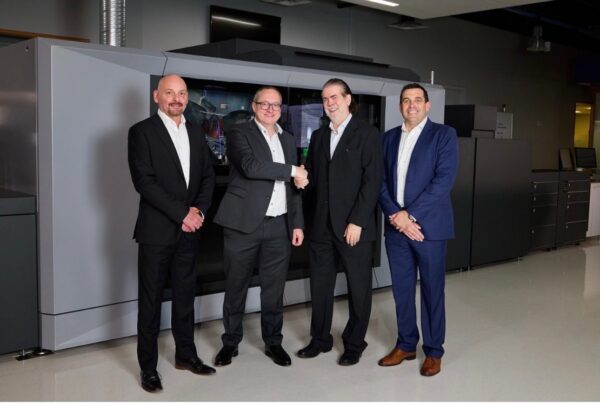
Joshua Howard, senior director, Inkjet R&D at Kodak (pictured at right), says, “With inkjet imprinting you’re looking at a much smaller footprint and lower capital cost than an inkjet press. To make the investment even more efficient, Kodak can mechanically equip multiple customer presses to support inkjet imprinting and then enable the customer to deploy the PROSPER print heads or Print Bar configuration at each equipped press, or post-press location as needed.” Customers are empowered to move their imprinting equipment from one system to another in a self-sufficient way without additional services from Kodak. When the customer’s demand for digital production grows, additional imprinting equipment may be purchased without the need for further integration downtime.
There are always tradeoffs in designing a solution. More colors and width require more space for mounting. Higher coverage increases drying requirements. There are also potential tradeoffs with automation of color stitching and registration control which are more or less critical depending on the type of application. Kodak works with customers to set priorities and identify options for placement of imprinting that ensure consistency and stability with the minimum of disruptions. On a web press this could involve installing on top of a roller or adding an additional transport and dedicated drying power.
The decision to add variable imprinting to analog processes is rarely about whether it works, or whether it adds value. Both of those points have been proven consistently. The more difficult question is where, and how deeply, inkjet should be inserted into an existing production model. Kodak has decades of experience with designing hybrid solutions that deliver value for customers. They continue to evolve their imprinting solutions to meet new requirements balancing a robust set of pre-configured options with the ability to create unique configurations to meet customer needs.