Since taking office earlier this year, Federal Reserve Chair Kevin Warsh has frequently expressed a desire to cut back on the messaging from Federal Reserve officials to get a clear “unfiltered” economics signal from the markets. In September, the bond market delivered a resounding signal. The yield on the 10-year Treasury rose 60 basis points to finish the month over 5.30%, its highest level since 2002. In its wake, borrowing costs for corporations and homebuyers rose a similar amount. September also saw oil prices once again move above $100 per barrel as tensions flared up anew in the Persian Gulf region.
Since the end of 2025, ten-year nominal yields (using the Fed’s constant maturity series) have gone up 115 basis points. Using the 10-year constant maturity inflation-linked bond, this increase in nominal yields can be decomposed into the increases in real yields (102 basis points) and implied expected inflation (13 basis points). The Fed can take some comfort in the fact that most of the rise in nominal ten-year yields has been in the real yield rather than the inflation expectations component. Even so, homeowners will have to pay more for their mortgages and businesses will face a similar effect in the corporate bond market.
The graph below shows the history of the Fed’s constant maturity 10-year real yield series:
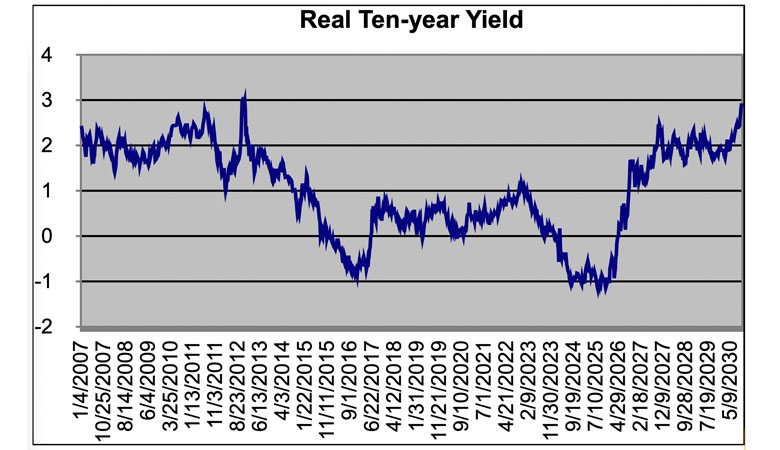
Several factors should be noted. First, 2008 to 2023 was a period of extraordinarily low interest rates, with monetary policy reacting aggressively to the Great Recession and the weak recovery that ensued and, later, to COVID. Second, the recent surge in the 10-year real yield takes it significantly beyond the range that prevailed in the 2003-2007 period before the Great Recession. While the TIPS market has not been around long enough to have a real-yield series for the 1980s and early 1990s, it is likely that real yields were higher for most of this period than it is now even after the recent runup. We may be entering a period of similarly high long-term real interest rates.
Economics: A period of high, long-term interest rates?
The recent runup has multiple causes, including strong borrowing due to capital expenditures related to AI, large government deficits, and increases in geopolitical risk premium. After six years of inflation significantly overshooting the Fed’s target, there may also be an increase in the inflation uncertainty premium. This is not the same as the expected inflation that can be inferred from the inflation-linked bond market. Any uncertainty premium (whether related to inflation or not) shows up in higher yields in both the real and nominal markets. This may be an additional factor at work in addition to the ones cited above. This raises the possibility that real yields could move well above the ones that prevailed in the years immediately before the Great Repression of 2008 to levels likely to have prevailed during the 1980s and 1990s when markets likely priced in a high inflation uncertainty premium due to memories of the high inflation experienced during the 1970s and early 1980s.
Long-term rates have been rising in other countries as well. Many of them (notably France and Japan) are dealing with large deficit and debt to GDP ratios. In addition, the capital expenditure boom related to AI is a global phenomenon, making demands on capital markets around the world and boosting growth in many places. The capital expenditures in the United States often consist of imported high technology products. During the first seven months of this year, imports of high technology products have risen to $693 billion, up from $546 billion during the first seven months of 2025 and $412 billion during the first seven months of 2024. This represents a 68% increase over a two-year period. While this boom in investment is to be welcomed in many ways, it is making it more expensive to finance other types of investment, including residential investment via mortgage rates.