Press release from the issuing company:
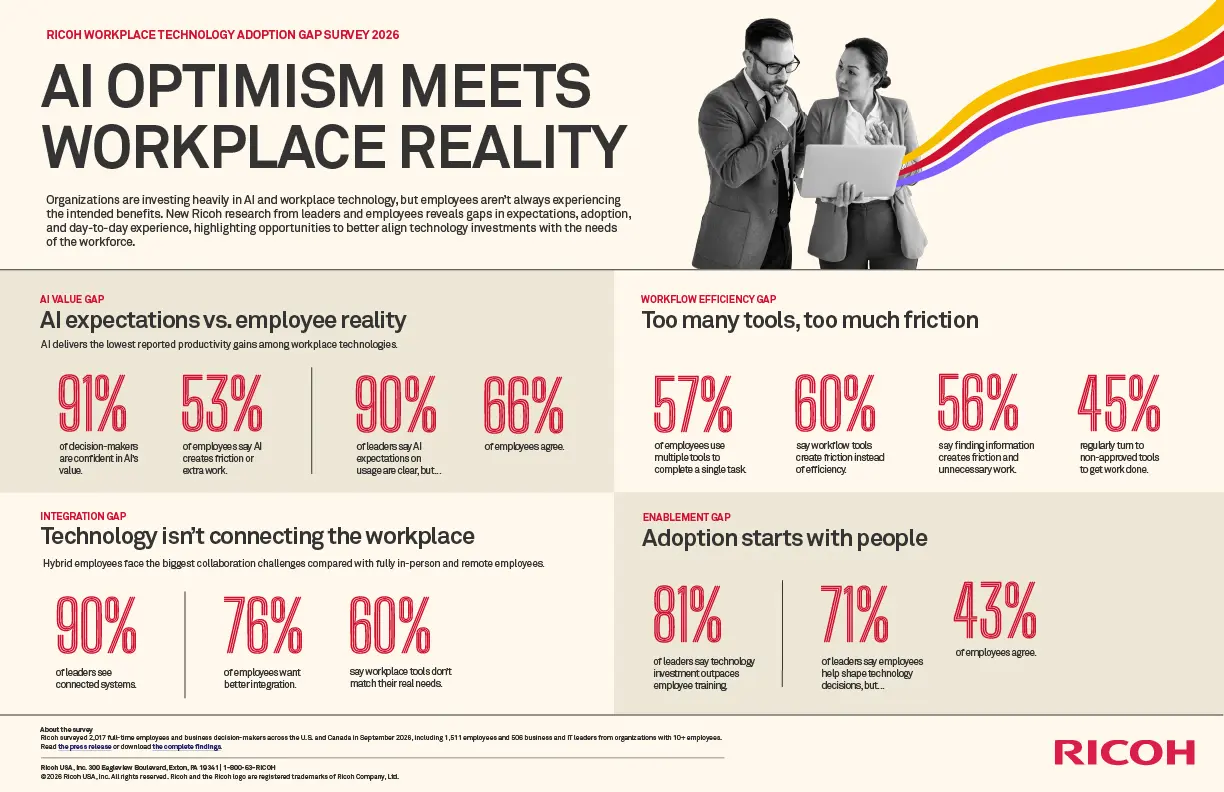
The 2026 Workplace Technology Adoption Gap survey released by Ricoh USA, Inc., a leading provider of integrated digital workplace solutions and services, explores the gap between business decision-makers’ confidence in workplace technology investments and employees’ experience using those tools.
The survey of a total of 2,017 employees and business decision-makers in the U.S. and Canada found that when new workplace technologies aren’t implemented effectively, they can create added complexity and costs rather than deliver expected efficiency gains. The findings show that deployment alone does not drive productivity, as disconnected technologies are affecting employees’ productivity while adding to organizations’ governance and security challenges.
Business decision-makers see value in AI, while employees reported friction
The majority of decision-makers (91%) are confident their AI investments are delivering the value they expected. Yet employees tell a different story as more than half of employees say AI creates friction or extra work (53%), while 55% say time spent managing workplace technology tools interferes with their productivity. AI tools also deliver the lowest employee-reported productivity gains of the four workplace technology categories tested, which also included communication/collaboration, information/data access and workflow/process management tools, suggesting that a gap between investment alone is not translating to an improved workplace experience.
“AI creates value when it makes work easier, not when it adds another layer of complexity,” said Carsten Bruhn, president and CEO, Ricoh North America. “Strategy must drive technology decisions, not the other way around. That strategy should start with people, and understanding what employees need to do their jobs effectively. Leaders need to understand how work gets done and where it breaks down before determining where AI and other technologies can make the greatest impact. The opportunity is to connect technology to the way people actually work, so adoption, productivity, and business value improve together.”
When technology meant to streamline work slows it down
Three in five employees (60%) say workflow and process-management tools create friction or extra work. Searching for information and navigating systems that do not work well together are among the biggest pain points reported. Meanwhile, leadership may see an integrated tech stack, but employees experience isolated islands of disconnected tools. Nine in 10 decision-makers (90%) believe their organization’s technology tools, systems, and processes are connected, and in contrast, more than three-quarters of employees (76%) say their jobs would be easier if those same tools, systems, and processes worked better together.
Hybrid work adds another source of friction. One-quarter of hybrid employees (25%) report difficulty collaborating with colleagues in different locations, compared with 16% of fully in-person employees and 14% of fully remote employees.
The survey also found a perception gap in cross-functional integration, as 70% of decision-makers say their organization’s technology is highly or well-integrated across different teams and departments such as IT, HR, and Facilities, compared with 55% of employees. This disconnect underscores a broader challenge as organizations work to scale workplace technologies across the enterprise.
“With AI deployments becoming more agentic, organizations cannot scale adoption without addressing the disconnect between leadership vision and daily work practices. Fragmented technology, data and workflows create avoidable complexity that many employees are left to navigate themselves,” said Amy Loomis, group vice president, Workplace Solutions at IDC. “Ricoh’s findings show that many leaders do not always see the disconnect their employees face, and closing it takes shared priorities across departments, strong governance and a common foundation for data and workflows, which can move AI from isolated use cases to scalable business value.”

Disconnected workplace technology opens the door to security and governance risks
More than half of employees (56%) say information, knowledge, and data access tools created friction or extra work in their day-to-day jobs. When employees cannot easily find information or complete work within approved systems, they may create their own path: nearly half (45%) say they use non-approved tools to get work done more easily at least monthly. Those workarounds can make it harder for organizations to maintain visibility and governance over how they manage information and workflows.
This gap extends to responsible AI use. While 90% of decision-makers say employees have clear guidance on how to use AI-enabled tools responsibly, only 66% of employees agree.
“When employees have to search across multiple systems, re-enter information or use unapproved tools just to complete routine work, those workarounds create friction and expose organizations to greater risk” said Bob Lamendola, chief digital services and delivery officer, Ricoh North America. “Organizations need to better orchestrate the technology, information and workflows they already have, while identifying where agentic capabilities can support manual work. Connecting those components can reduce risk and make the approved path the easiest path for employees to get work done.”
Workplace tool implementation must start with employees, not technology, Ricoh study finds
Three in five employees (60%) say there is a disconnect between the tools their organization thinks would be most useful and the tools that would be most useful to them. The disconnect also extends to how organizations believe they are managing change. While 71% of decision-makers say their organizations usually seek employee input before rolling out new technology, fewer than half of employees (43%) say that usually happens.
The report also points to a gap that workplace technology is arriving faster than many organizations can support effective adoption. More than four in five decision-makers (81%) say their organization invests in new workplace technology faster than it helps employees learn to use it effectively.
The findings point to a clear takeaway: effective technology adoption begins well before deployment and requires more than investment. Organizations must design workplace technology around how work gets done by seeking employee input early, targeting real needs, integrating tools into existing workflows, and providing clear guidance for effective use.