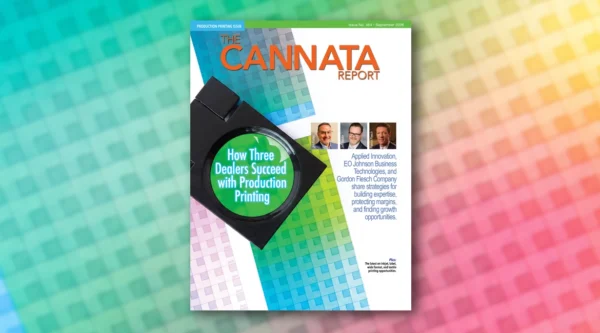
We assembled an excellent group of dealers to share their knowledge of production printing. We have been advocating that dealers look upon production printing as a means of diversifying and improving profitability. Results from The Cannata Report’s Annual Dealer Survey confirm that production printing, along with managed IT services, represents 38% of total dealer revenue.
Our experience tells us that dealers prefer to hear from their fellow dealers about how to proceed, especially in a new area for them. Market potential is one thing but exploiting that potential is a whole other issue. Applied Innovation (AI) is a Canon and Ricoh dealer that has enjoyed considerable success in this space and is highly regarded by fellow dealers as well as manufacturers. We welcome Jim Fortier, the Grand Rapids, Michigan-based dealership’s production print sales manager.
We also spoke with Patrick Flesch, president and CEO of Madison, Wisconsin-based dealer Gordon Flesch Company (GFC), and additionally, had the pleasure of revisiting with EO Johnson Business Technologies, which covers the market from its customer experience center in Wausau, Wisconsin. Dave Greene, the former president, recently retired and has been replaced by Kris Kilgard, who connected us with Jeff Reuter, EOJ’s director of production printing:
As a dealership that has demonstrated a great deal of knowledge regarding production print. How important do you feel this segment of the business is to your overall success?
Jeff Reuter: The production segment is especially important to the overall success of EOJ and, over the past decade, has helped us stay relevant in the industry. As a sales and service organization, like most in the industry, we depend on the recurring revenue that service brings in. Over the years, as office print volumes declined, we were able to maintain our monthly recurring revenue by having high-volume production accounts across multiple verticals. We have some solid placements in corporate in-plant print shops, commercial printers, and education accounts that keep the digital print clicks coming in on a very consistent basis.

Amid page volume declines, EO Johnson maintains its monthly recurring revenue with high volume production accounts across multiple verticals. reports the dealership’s Production Printing Director Jeff Reuter (at right).
Jim Fortier: Production print is an important and growing segment of Applied Innovation’s overall business because it allows us to deliver higher-value solutions beyond traditional office print. It strengthens customer relationships, supports larger and more strategic opportunities, and helps differentiate Applied as a consultative partner rather than simply an equipment provider. While it may not represent the largest portion of total revenue, it is important to our long-term success because it brings specialized expertise, recurring service opportunities, and meaningful account growth potential.
Patrick Flesch: Production can be tricky. At GFC, we have found much more success in this area when we are working with accounts that have a walk-up office fleet as well as a production printing room. We are able to position more value in these scenarios. When involved with commercial printers and print-for-pay outfits that can be more challenging, and pricing seems to be the top priority. In those cases, our margins tend to suffer and, depending on volumes, we are at risk of losing money. So, we are more disciplined these days on only pursuing production opportunities where we are able to position our value and preserve healthy hardware and service margins.
Is there one area that you believe your dealership has been particularly proficient in? Specifically, in this response, are you referring to overall sales, profitability, or something else?
JR: Historically, EOJ has done very well with overall sales across the above-mentioned verticals. We also have not shied away from the commercial print space but instead have fully embraced it. With our finishing side of the business coupled with the digital print and production supply business, we can provide a full-service end-to-end solution for many types of production-related placements. Many dealers dabble in this type of sale, but EOJ excels in this area.
JF: Applied Innovation has been especially proficient in building credibility with customers through knowledge, responsiveness, and the ability to match the right solution to the right production environment. I would view that proficiency as a combination of sales execution, customer retention, and workflow automation. Production printing requires more than placing equipment; it requires understanding workflow, volume, uptime, finishing, color, expectations, and application needs. Our strength has been approaching those opportunities with a solutions mindset.
One of the major manufacturers has recently introduced industrial production print to its inventory for dealers. Initially, they are stressing labeling. Is that an area in which you have participated in the past? If you have not, are you receptive to taking on this opportunity? If not, why not?
JR: EOJ has had label printers as part of our offerings for some time. We do not sell a ton in this space and have looked at some high-volume options in the past, as our geography has a high concentration of label converters, but that market is tough to break into without specific knowledge and expertise. It is something on our radar, but we have not jumped in with both feet yet.
JF: Labeling is an interesting opportunity and one that fits naturally with the broader movement toward industrial and application-specific print. We have not been heavily involved in that space historically, but I would be receptive to evaluating it. The key questions would be whether there is sufficient customer demand in our markets; whether the manufacturer provides intense training and support; and whether the opportunity aligns with our sales and service capabilities. I would not reject it simply because it is new, but I would want to make sure we enter the space deliberately and with the right resources.
PF: To my knowledge, we have not represented an industrial label printing solution, but would be open to the offerings if presented to us by our OEM partners, Canon and Ricoh.

Patrick Flesch is CEO of Gordon Flesch Company.
You have a broad range of products from your most important manufacturers in production printing. Do you believe that adding other manufacturers to your inventory, because they bring something you are not currently able to supply, is a promising idea? Do you carry multiple brands?
JR: In keeping with a strategy of being best in class, we sometimes take a pass on a specific product if it is something that we feel will not contribute to that. One example is some of the earlier inkjet manufacturers that approached us to carry their product. We did not want our name to be associated with something that we felt would not perform well for our clients.
JF: Applied Innovation is a multibrand company, and adding another manufacturer can make sense if it fills a clear gap in the current portfolio and helps us solve customer problems we cannot adequately address today. Production printing customers often have extremely specific needs related to volume, substrate, color, uptime, finishing, workflow, and total cost of operation. Multiple brands can be valuable when they expand our ability to recommend the best solution rather than force-fit one product line. However, carrying multiple brands also requires discipline because each line brings training, inventory, service, and support requirements. The decision should be driven by customer needs and business opportunities, not simply by the desire to add another product.
PF: We have evaluated this recently and have come to the conclusion that the upside of bringing on another line to fill minor gaps in our production lineup is not in the best interest of GFC. We feel that between Canon and Ricoh, our production offerings present great value and are feature-rich for the market.
A significant production printing application is best provided by a product using inkjet. Our research indicates the reason it has been successful is because, with inkjet, you can quote the lowest cost for full-color printing. Does this make sense to you and, if not, why not?
JR: This statement is somewhat true. The inkjet market is growing daily, and yes, there are some products out there that have exceptionally low cost-per-page options. While this is definitely high on a production customer’s list of reasons to get into an inkjet product, there are quite a few other factors that can influence their decision. Many commercial printers also require elevated levels of availability, consistency, and automation to be competitive. It is also important that they understand the best ways to finish the printed output of their inkjet presses and how that fits into the equation. The team here at EOJ has been studying this market for quite some time to ensure that we provide this high level of knowledge and give our clients and prospects as much info as we can to help them learn and make an informed decision on which way to take their business. If they do not succeed, neither do we. This is a roundabout way of saying that the lowest cost of operation is not always the correct option.
JF: Yes, that does make sense. Inkjet can be very compelling in production environments where full-color volume, speed, and cost per page are major factors. For certain applications, inkjet offers a lower operating cost and the ability to produce color work more economically than toner-based alternatives. That said, the fit depends on the application. Image quality expectations, substrate requirements, finishing needs, coverage, service model, and monthly volume all matter. Inkjet is not automatically the answer for every production print customer, but where the application aligns, the cost advantage can be significant.

Jim Fortier is the production print sales manager at Applied Innovation.
PF: We agree and are anxiously awaiting the release of the Canon iX1700. We think this inkjet technology can be a game changer for us in the production space. We have several customers/prospects expressing interest in this product and look forward to taking it to the market when available.
What advice would you give to a fellow dealer who does not participate in production printing but has interest? How should he or she start building that capability; what should be the first step?
JR: My main advice for other dealers has always been to make sure you master one thing before you try and bring on another. If you can be the best at one specific product or vertical, concentrate on that first. Hone your skills, develop your people, get some solid success, then move on to the next thing. EOJ grew our production business from scratch and followed this model for the last 20+ years, which is why we are where we are today.
JF: My advice would be to start by building knowledge before trying to sell production printers as just another product category. A dealer should begin by identifying customers with production-type needs already in their base, then invest in manufacturer training, application knowledge, and workflow understanding. The first step should be to choose a focused entry point and develop internal champions who can support both sales and service. A dealer does not need to become an expert in every area immediately, but they do need a committed plan, strong manufacturer support, and a willingness to approach these opportunities consultatively.
PF: Investing in technical resources that can provide expertise and support during the sales process is critical. Buyers in this space are very knowledgeable and will need to trust that the dealer will provide the appropriate solution as well as post-sale support.
VIDEO: Virginia-based dealer Cobb Technologies hosted a Production Printing Showcase this summer.
Sharp Makes an Impact on Production Print
We also had the pleasure of interviewing Dino Pagliarello, vice president of product management and production print at Sharp Imaging and Information Company of America. What he and his team have done has brought the manufacturer into the game in less than 2½ years. That is quite a feat, and we are eager to see what Sharp will show at PRINTING United Expo 2026.

Dino Pagliarello is VP of product management and production print at Sharp.
You received some positive comments from dealers about Sharp in production printing in our last Survey. Can you bring us up to speed on where you are currently?
DP: We’ve identified three key areas of positivity:
- Dealer Sentiment Is Improving—driven by real progress. IDC’s latest production marketscape calls Sharp a “major player.” There is a lot of excitement from the dealer community for what is coming next.
- Strong Foundation Built Quickly—products + programs + tools: sales tools, competitive guides, product positioning tools, print samples, training.
- Product Momentum Is Real—especially around new platforms. We’ve received strong product feedback regarding image quality and positioning.
For dealers who had no experience in production printing prior to taking on Sharp’s initial offering, how would you gauge their overall response to the challenges they faced, and are there any instances where you thought they did better than expected?
DP: There was a learning curve—production print is a more complex business—but what has been encouraging is how quickly many of our dealers adapted. The biggest challenges were around execution and process, not the product itself. And in several cases, dealers with little prior experience were able to ramp faster than expected, win competitive deals early, and even lean into more advanced applications like specialty color. That has been a positive sign for us. In several cases, dealers with little or no prior production experience were able to:
- Adopt application-based selling much faster than anticipated
- Leverage our training, demo programs, and experience centers effectively
- And, importantly, win competitive deals earlier than we would have predicted
How have you approached building the availability of EECs (executive experience centers) for Sharp dealers to exploit the business? (For the benefit of our readers who may not be aware of how important EECs are to facilitating closing, a dealer can take a prospect to a Sharp facility and demonstrate the product with the help of an SME who works there.)
DP: Strategic investment was key. We made a deliberate investment in our executive experience centers so dealers—especially those new to production—could immediately bring customers in and demonstrate real applications with the support of our experts. It has helped accelerate deal cycles significantly and, over time, we pair that with training so dealers can build that capability themselves.
There are many applications in production printing. Can you share with us which of those applications have been the most embraced and exploited by Sharp dealers?
DP: Production printing does have a diverse variety of applications and environments. Dealers have started with familiar applications, like in-plants and commercial print, but what has been encouraging is how quickly they have moved into higher-value areas such as specialty color and embellishment. That is where they are really starting to differentiate and win.

Pagliarello says Sharp will reveal some production surprises for visitors to PRINTING United Expo in Las Vegas this month. (A six-color digital press from the OEM’s BP-1200 Series is pictured in the OEM’s Montvale, New Jersey Executive Experience Center.)
Early on, the most embraced applications have been what I would call the ‘core production adjacencies:
- In-plant and CRD environments
- General commercial print/print-for-pay
- Marketing collateral and short-run color work
We are also seeing strong activity in verticals, like:
- Education and government in-plants
- Corporate marketing departments bringing work in-house.
We have heard that you have had some success with dealers who were not primarily Sharp dealers but successful in production printing with other manufacturers. What can you share?
DP: It is all about specialty color and profitability. We are seeing experienced production dealers gravitate toward our BP-1200 series and the 85/100 ppm platforms, primarily for differentiation—especially in specialty color—and for where those products fit in the lineup. In many cases, they are adding Sharp very strategically to address gaps they could not cover as effectively before.
PRINTING United Expo is in sight. Can you share anything about specific focus you will have at this year’s event?
DP: Surprises to come!
Frank’s takeaway
Sharp has made an excellent plan for getting up to speed with production printing. We attended one meeting where a team of experts delivered, in a brief period, a program on how to gain significant knowledge. Their employees provided excellent support for the entire selling process.
Kudos to Pagliarello and his team, who have helped make it possible for many dealers to diversify their businesses and develop a new revenue stream that will, if executed properly, negate any concerns about the future of the “dealers in the print business.” By adding production printing to its inventory, the OEM has also improved the ability of engaged dealers to improve profitability.
AVAILABLE ONLINE ONLY: A look back at what other manufacturers and dealers have done in production printing over the past six years.