While opting to keep interest rates unchanged at its October meeting, the Federal Open Market Committee displayed signs of impatience about the pace of progress against inflation as it watched economics in the United States and hinted that additional rate increases were likely. There were two dissents in favor of a 25-basis point tightening at the October meeting. Those dissents, along with recent comments by other FOMC members, indicate that a tightening is likely at the committee’s next meeting in December.
The FOMC’s inclination to tighten its policy regarding economics appears to be mainly based on concerns that progress in returning inflation to its 2% target has stalled. However, recent wage inflation data show an ongoing deceleration. The Employment Cost Index (ECI) for private sector workers rose 0.8% in the third quarter. This was a slight deceleration from the 0.9% increase reported for the second quarter. The table below provides data on labor cost inflation from the average hourly earnings (AHE) series for production and nonsupervisory workers and the ECI for private sector workers. The 2026 data represent the annualized rate of change for the first three quarters.
Taken together, these two measures show stable or slightly slowing labor cost inflation so far in 2026. Along with the rental vacancy rate data released earlier this week, these data reinforce our view that core inflation is likely to decelerate slightly over the next two years. The core CPI has increased by 2.6% in the past year. We expect it to slow to 2.4% over the next year (October 2027 over October 2026) and 2.2% in the following year (October 2028 over October 2027).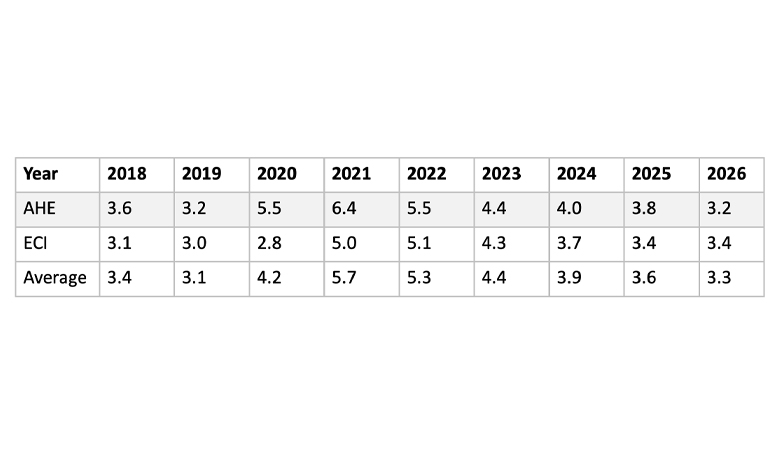
U.S. economics: Purchasing power could drop for the first time in four years
Compensation growth, whether measured by average hourly earnings or the Employment Cost Index, has not been keeping up with inflation. Real purchasing power, a key metric of economics, is on track to fall by about 1% this year. This would be the first decline since 2022, mainly reflecting higher energy prices, and it highlights the Fed’s dilemma. Inflation is too high and real consumer purchasing power has been falling. Consumers have been tightening their belts to make ends meet, as manifested in the savings rate falling from 4.9% to 3.8% in the past year. Interest rate hikes will take a further toll on consumers in the form of higher mortgage rates for those attempting to finance the purchase of a home.
The lack of compensation growth is something that will restrain inflation going forward. Labor costs are a significant part of the costs of production. Furthermore, the loss of purchasing power will reduce demand.
There is an additional reason to expect inflation to fall over the next two years even without additional action by the Fed. The national rental vacancy rate has been rising and is now at its highest level in over twelve years. This has already led to a significant deceleration in rents. With the rise in the rental vacancy rate continuing in recent quarters, it is likely that rental inflation will decelerate further in 2027 and early 2028.
The movements of worker compensation and the rental vacancy rate constitute a solid case for patience on the part of the FOMC. It is true that inflation has yet to return to the Fed’s 2% target, but some of this reflects one-time shocks, including the effects of the war on energy supplies from the Middle East. Inflation expectations have remained well-anchored even in the face of those shocks. However, it does not appear that the FOMC is inclined to show much patience at its December meeting.