This article is adapted from an EO Johnson blog:
Personalization has become an expectation in marketing. Customers receive emails tailored to their interests, product recommendations based on previous purchases, and digital ads that reflect their browsing behavior.
But personalization isn’t limited to digital channels.
With variable data printing (VDP), commercial printers, in-plant print departments, and marketing teams can deliver that same level of relevance through physical mail. And unlike traditional print runs, where every piece is identical, variable data printing makes it possible to create thousands of unique mailers in a single production run.
For print providers, that represents more than a new capability. It’s an opportunity to deliver greater value to customers, expand services, and make direct mail more relevant.
What makes variable data printing different?
Traditional printing produces identical copies of a document. Variable data printing uses digital technology to change text, images, offers, and other elements from one printed piece to the next without stopping the press.
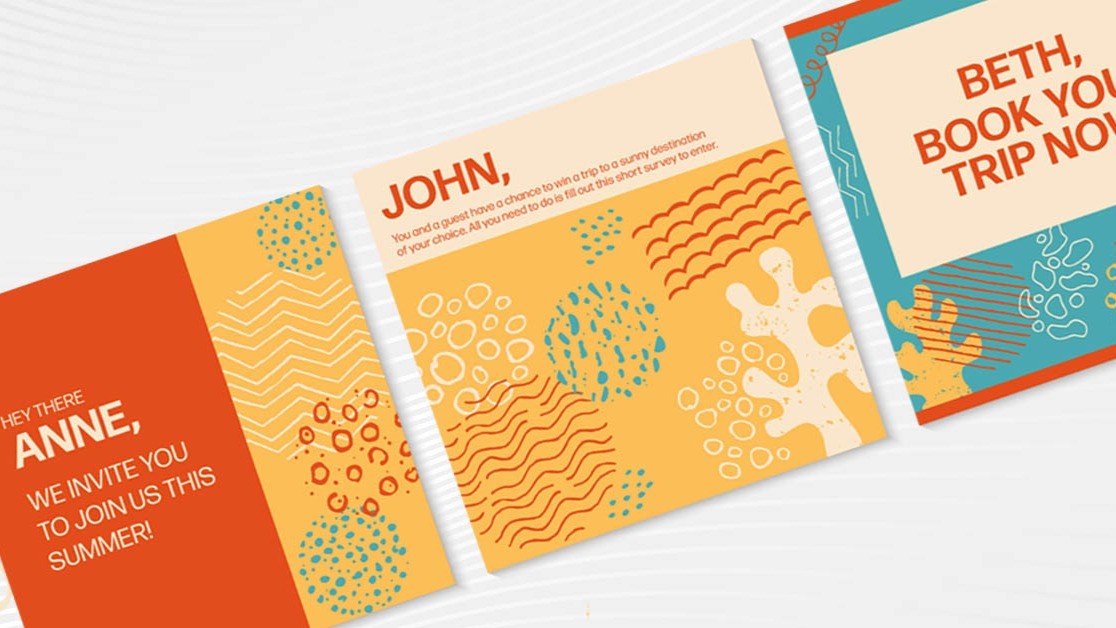
Imagine a retailer mailing 10,000 postcards. Instead of sending the same promotion to every household, each recipient receives a customized offer based on their location, interests, or previous purchases.
One campaign. Thousands of variations. One production run.
The process connects a design template to a database containing customer information. Variable data software merges the records into the template, allowing the digital press to produce personalized pieces at production speed.
The technology creates opportunities for both marketing mail and transactional printing, including statements, invoices, account notices, and other communications requiring recipient-specific information.
Why personalized direct mail deserves a place in modern marketing
Digital marketing may dominate conversations about personalization, but physical mail offers something different: a tangible message that recipients can hold, review, and return to.
Adding personalization makes that experience more relevant.
“While digital marketing often grabs the spotlight, personalized print materials have a unique ability to create lasting impressions,” says Tracey Armstrong, Vice President of Marketing at EO Johnson Business Technologies.
For organizations investing in direct mail, variable data printing offers several advantages:
- More relevant messaging. Personalized names, offers, images, and locations help mailers connect with individual recipients.
- Greater production flexibility. Thousands of personalized variations can be produced without creating separate print runs.
- More efficient marketing spend. Targeted offers reduce reliance on generic campaigns that may not resonate with recipients.
- Faster campaign execution. In-house production gives organizations more control over turnaround times and last-minute changes.
“Marketing teams often assume personalized mail means a bigger budget. With clean data and the right equipment, that isn’t necessarily the case because you stop paying to print and mail pieces that are generic and don’t really speak to anyone.”
— Tracey Armstrong, vice President of marketing, EO Johnson Business Technologies
Where variable data printing creates opportunities
Personalized printing isn’t limited to adding someone’s first name to a postcard. The applications extend across industries and communication types.
Retail and marketing: Personalized coupons, loyalty offers, and product recommendations based on purchase history.
Financial services: Account statements, regulatory notices, and customer communications containing individual account information.
Healthcare: Appointment reminders, patient statements, and personalized communications produced with appropriate privacy and security controls.
Nonprofits: Fundraising appeals that reference previous donations, campaign interests, or community impact.
Manufacturers and dealers: Co-branded campaigns featuring individual dealer locations, regional promotions, and unique offers.
Events: Invitations with personalized RSVP codes, location-specific details, or unique registration links.
For commercial printers, these applications can open conversations with customers about services beyond traditional print production.
Choosing the right production print technology
Not every variable data printing application requires the same equipment.
Print volume, media requirements, image quality, and finishing needs all influence which production print system makes sense.
Here are four options worth evaluating:
Kyocera TASKalfa Pro 15000c
Designed for high-volume, full-color production, this inkjet system is well suited for large personalized mailing campaigns and transactional applications. Its cost-per-page economics make it an option for organizations seeking to bring recurring mail production in-house.
Canon varioPRINT iX1700
This production inkjet press combines high-volume output with support for coated and uncoated stocks. Native support for variable data formats, including PDF/VT and PPML, makes it a strong option for recurring personalized mail programs where print quality matters.
Ricoh Pro C7500
For mailers that need to stand out, the Pro C7500 offers a fifth color station with specialty toner capabilities, including metallic, neon, white, and clear options. It’s especially useful for high-impact direct mail pieces and creative campaigns.
RISO ComColor GL Series
These high-speed inkjet systems are suited for addressing, inserts, and simpler color mail applications. Their heat-free printing process produces flat sheets that can move efficiently into folding and inserting equipment.
The right equipment depends on the work you’re producing today and the opportunities you want to pursue tomorrow.
 Canon varioPRINT iX1700, Ricoh Pro C7500, and RISO ComColor GL Series" width="800" height="1000" title="EO Johnson on Variable Data Printing 4">
The biggest VDP challenges aren’t always at the press
Investing in a production printer is only one part of building a successful variable data printing operation.
The full workflow matters.
Data quality: Inaccurate names, outdated addresses, and incomplete customer records can undermine even the best personalized campaign.
File preparation: Templates and variable content must be structured correctly to avoid production errors.
Workflow integration: The printing process needs to connect efficiently with existing systems and data sources.
Finishing and mailing: Folding, inserting, addressing, and sorting must keep pace with print production. Transactional applications may also require piece-level tracking and additional security controls.
Operator training: Teams need to understand the entire variable data workflow, not just how to operate the press.
For organizations considering bringing personalized mail production in-house, these factors deserve as much attention as print speed or image quality.
Personalized print is an opportunity to deliver more value
Variable data printing changes the conversation from How many pieces can we print? to How much more effective can we make every piece?
For commercial printers, that creates opportunities to offer higher-value services and become more involved in customers’ marketing strategies.
For in-plant print departments, it provides a way to increase the value of internal production capabilities.
And for marketing teams, it creates another channel for delivering relevant, personalized communications.
The opportunity isn’t simply to print more. It’s to make what gets printed matter more.
Considering variable data printing for your operation?
EO Johnson Business Technologies helps commercial printers, in-plant print departments, and marketing teams evaluate production print equipment, workflow integration, and finishing solutions.
Explore our production print solutions or take a virtual tour of our Customer Experience Center in Eau Claire, Wisconsin. →