

At the start of summer, we ventured to Hanover Park, Illinois, near Chicago, for Fujifilm’s “Unveiling the New Standard in Print” production printing event. There, amid an audience of approximately 100 people, the OEM’s six-color Revoria Press PC 2120 made its North American debut. The toner-based A4 device can print at speeds up to 100 pages per minute (ppm). The tech talk track revolved around green and pink fluorescent color additions and digital-embellishment premium margins.
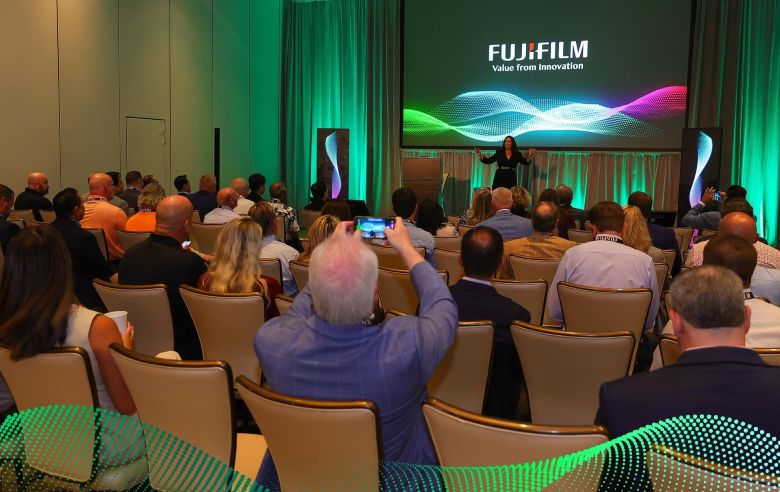
Exactly three months later, we found ourselves in Las Vegas at the Four Seasons/Mandalay Bay Resort. This smaller crowd also included prospects, but the discussion was broader at Fujifilm’s Dealer Growth Acceleration Summit. Elisa Esposito, new head of Fujifilm’s commercial division as of April, served as emcee for the afternoon event. Esposito is an industry veteran who spent 19 years with Ricoh before directing marketing programs and channel marketing for Konica Minolta. She introduced some corporate top brass, including Ryuichi (“Ritchie”) Matoba, president & CEO of Fujifilm North America, as well as a special guest from Japan: Toyoyuki (“Tommy”) Katagiri, head of new market business development. Katagiri emphasized the company’s 60 years of toner experience and rich, 90-year overall history.

Corporate Product Development VP Kazuo Tamura, another Japanese guest, teased the audience with news of a new A3 product, coming in Q4 ‘26, in the low- to mid-speed segment. Watch for high-speed monochrome and A4-related announcements, too, heading into FY 2027.
On the sustainability front, Tamura explained how Fujifilm is improving low-temperature fusing performance. Its engineers have developed ELFEAT by enhancing toner viscosity response to temperature during fusing, which means it can be fused at temperatures nearly 60° (Fahrenheit) lower than those of Super EA-Eco toner. The technology saves energy and lowers CO₂ emissions by more than 60%, he noted.
What’s the dealer strategy?
Esposito then outlined her commercial vision, emphasizing the importance of office technology dealer partnerships. Two big takeaways:
- Territory realignment and service/distribution expansion are in the works.
- Repositioning of the Fujifilm brand within the channel will help dealerships resell the manufacturer’s products.

Elisa Esposito
New channel partners were in the house at the dealer summit. Representing print-management service provider ecoprintQ were COO Dominick Bracero and Business Development Manager Ross Wood. Also taking the stage was Kevin Tetu, president of MPS Monitor and NEXERA’s Managed Print Division.
Meanwhile. National Sales Manager Scott Atkinson shared information about Fujifilm’s growing production printing presence. On the eve of PRINTING United Expo 2026, he encouraged attendees to visit its exhibit booth. In terms of business diversification, Atkinson believes the light production space is easier for imaging equipment dealerships to enter (and less of a gamble: Vegas pun intended) than managed IT services or even wide format printing. The OEM’s Aspire Program, which features a free suite of training resources and tips for designers and operators, is a great way to get started, he said. Aspire also provides promotional print samples and profit estimation tools designed to accelerate growth and return on investment.
Next, Atkinson (top photo, far right) served as one of five panelists assembled for the summit. Moderated by Anne Valaitis, principal analyst in Keypoint Intelligence’s Workplace Team & Customer Communications Solutions group, other panelists included a pair of Fujifilm partners:
- Eric Pitassi, president of Austin, Texas-based dealer Altura Solutions and ImpactWest (Irvine, California)
- Mark Phillips, COO of St. Louis-based dealer SumnerOne and its Production Print Solutions (PPS) subsidiary
- Patricia Ames, industry analyst and president of BPO Media
- Mike Stramaglio of Stramaglio Consulting, The Consortium, and the Executive Connection Summit
Valaitis stressed that dealers and OEMs alike operate in a “service industry.” She particularly noted changes in consumer behaviors over the past decade. Stramaglio urged dealers at the summit to approach production printing as “additive” to services they already provide. Pitassi, who became a Fujifilm partner earlier this year, preached the importance of owners being forward-thinking. He also recommended treating production printing as a separate business with its own P&L (profit and loss) tracking.
When scaling up investment, having capital resources is important, Ames pointed out, but even more critical is the willingness to take risks, Pitassi believes. He also advocates the use of AI as a tool that can help dealerships do more with less in terms of toner, parts, and labor.
SumnerOne’s Phillips addressed other dealer challenges, including print-volume compression. Whether the choice is staying with A3 products or moving to the A4 format, “ignore the noise and focus on what you are,” he advised. “Then, deliver to your clients.”
Stramaglio emphasized engagement and staying close to customers. The lifecycle management business model is exciting, he thinks, and interoperability is a key component for ongoing success. Regarding AI technology, Stramaglio asked: “Is your customer smarter than you, as a distributor?” If so, “fix it!” He suggested that one way dealers can improve customer communication is by forming Client Advocacy Councils.
Panelists also pondered a tiered future regarding technical service options. Customers receive the level and response times they are willing to pay for, of course, but not everyone needs instant gratification—and the premium price tags that go along with it. The bottom line is finding “widgets” that fit a dealership’s model, Pitassi concluded. Answers could come from somewhere unexpected. “Mailing goes hand in hand with production printing,” he shared, and, guess what? “Our mail business has tripled in three years and is profitable.”
Fujifilm’s spin(off)

Announced in mid-August, Fujifilm Holding’s intent to spin off an 80% stake in its North American printing business was the proverbial “elephant in the room” in Vegas. Dealers wanted to know about the manufacturer’s wish to voluntarily sell its Business Innovation Division (the copier subsidiary formerly known as Fuji Xerox). After all, the BI business represents the OEM’s largest business, accounting for 35% of sales. Corporate Vice President Taisuke Tarumi addressed the subject, saying that Fujifilm seeks a partner. “We expect this process to take a few years,” he noted. primarily due to Japanese legislative guard rails.
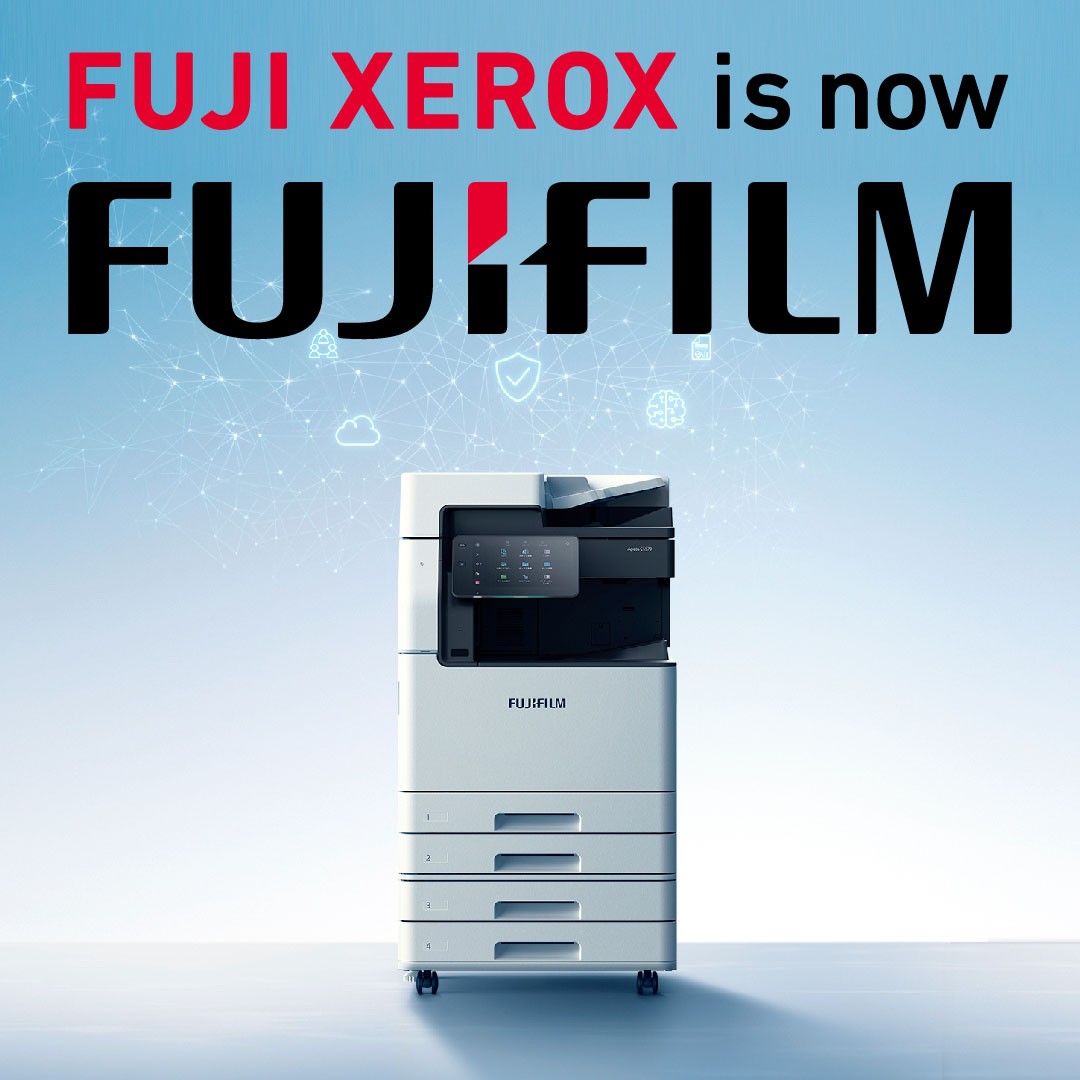
For nearly 60 years, FUJIFILM’S Business Innovation subsidiary was known as the Fuji Xerox partnership. Fuji Photo Film owned 75% and Xerox Corp. owned 25% of the joint venture, which was dissolved in 2019.
Who that partner might be remains to be seen, but there essentially will be an IPO involved priot to 2029. We speculate that how the Xerox-Lexmark merger continues to play out in the channel may have a lot to do with whichever company decides to step up and seize the opportunity.


