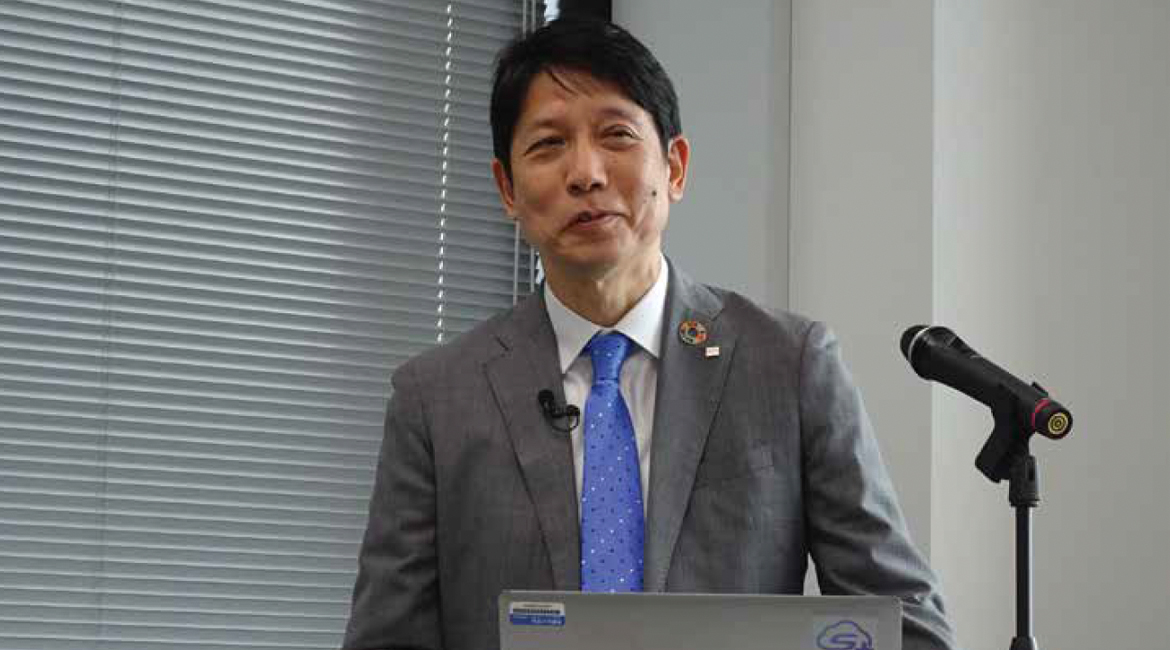
On September 18, Koji Miyao (pictured above), corporate senior vice president of Ricoh and president of the Ricoh Graphic Communications (RGC) business unit, outlined the outlook and strategic investment plans for RGC, one of Ricoh’s growth businesses.RGC comprises commercial printing, industrial printing, and functional printing, which was added in fiscal 2026 as a new pillar of growth.
The global commercial printing market, which encompasses direct mail, books, and invoices, is shifting from analog to digital printing and growing at an average annual rate of 5.5%. The industrial printing market, which includes signage, textiles, and packaging, is also growing at an average annual rate of 6.7%.
RGC’s revenue rose steadily from ¥187.0 billion in fiscal 2021 to ¥292.6 billion in fiscal 2024. Although revenue fell to ¥284.0 billion in fiscal 2025 amid the effects of U.S. tariff policies, Miyao said the business is recovering in fiscal 2026. Approximately 50,000 companies worldwide use Ricoh toner-based presses for commercial and industrial printing. By region, the Americas account for 50% of commercial and industrial printing revenue, Europe, the Middle East, and Africa for 25%, and Asia-Pacific and Japan for 25%. Growth is expected in all regions.
Commercial Printing
Commercial printing revenue totaled ¥244.9 billion in fiscal 2025, accounting for 86.2% of RGC’s total revenue. The first element of its growth strategy is to support customers’ business transformation. Ricoh will continue to support short-run printing with toner-based presses while using inkjet presses to serve medium- and long-run jobs, expanding the range of applications covered by digital printing.
The second element is to further improve product quality, deliver greater added value, and maximize profitability worldwide. In developed markets, Ricoh will advance solutions for automation, labor savings, operational visibility, and energy efficiency. In emerging markets, it will expand its business through products and customization strategies tailored to regional and customer needs.
Industrial Printing
Industrial printing revenue totaled ¥39.0 billion in fiscal 2025, accounting for 13.7% of RGC’s revenue. Ricoh aims to capture growing demand in this business by innovating its manufacturing processes and strengthening supply capacity.
As part of this effort, Ricoh will construct a new building at its Atsugi site in Kanagawa Prefecture to accelerate the growth of its inkjet business. RGC plans to grow its existing businesses and expand into new ones with inkjet technology at the core. The new Atsugi building is a central investment supporting that growth strategy.
Within its existing industrial printing business, Ricoh will secure production capacity that exceeds twice the current level to meet growing demand for printheads. In commercial printing, it will use high-speed inkjet presses to capture mid-volume print jobs. For new industrial printing applications, Ricoh will expand printhead supply for packaging, labels, and DTS, or direct printing on three-dimensional objects. Brand owners’ sales strategies are driving greater product variety in everyday goods such as detergents, fueling a trend toward more short-run inkjet printing.
In functional printing, Ricoh aims to create customer value and help address societal challenges by using inkjet technology to digitally transform manufacturing.
RGC plans to transform manufacturing in the new building at the Atsugi site in preparation for a shrinking workforce and intensifying competition. By using production automation and AI to embed skilled workers’ experience, intuition, and judgment into organizational capabilities, it aims to achieve strong profitability through high quality, low costs, and stable, around-the-clock operations.
Functional Printing
In functional printing, RGC is developing a next-generation business as a new pillar of growth. One of the new businesses Ricoh is pursuing is perovskite solar cells. Conventional silicon solar cells are rigid, thick, and heavy. Perovskite solar cells, by contrast, are thin, lightweight, and flexible. They are attracting attention as a forward-looking solar technology that can generate energy on curved surfaces of existing buildings and make effective use of wall space.
Ricoh has established a technology for producing the multilayer structure of perovskite solar cells through inkjet printing. The conventional process generally involves coating an entire surface and then removing material to form patterns. Ricoh’s inkjet printing process eliminates the need for expensive production equipment such as laser-processing and vacuum-deposition systems. It also allows production equipment to be smaller and simpler, reduces material and energy losses, and improves productivity. Ricoh is working with partner companies to commercialize these solar cells, targeting 2030 following demonstration trials around the world.
To manufacture these inkjet printheads efficiently and ensure a stable supply, Ricoh announced that it will construct a new building at its Atsugi site as a core production base supporting the inkjet business. Construction is scheduled to begin this month (November 2026), with completion planned for the first half of fiscal 2028. The four-story building will have a total floor area of approximately 39,000 square meters. Once operational, it will establish the capacity to eventually expand inkjet printhead production to more than twice the current level.
Drawing on its longstanding strengths in ultra-precision manufacturing and quality assurance, Ricoh will introduce automated production lines and robots capable of flexibly manufacturing a wide variety of products in the new building. The company will also capture skilled workers’ experience and expertise as data and use AI to inform decisions about production conditions and quality. By passing these skills on to the next generation, Ricoh aims to create a “next-generation factory where people and AI co-create.”