PRINTING United Expo, Las Vegas, Nevada, September 23–25, 2026: The doors were wide open to experience the current and future state of what is called print. And print is now the whole world I was always hoping for, not just an ecosystem.
Whether the more than 27.000 visitors from over 100 countries around the globe were looking for traditional printing “workhorses,” trying to understand where production print is going—from prep work to finishing—or exploring how to expand and diversify their portfolio, Halls N and C held something for everyone, from beginners to seasoned professionals. With nearly 850 exhibitors and co-exhibitors and more than 200 educational sessions, hardly any questions were left unanswered*.
All our known “suspects” unveiled or previewed new hardware and software for light- and heavy-duty production (transactional, embellishment, a wide variety of substrates, books…) printing. Wide format, textile, and direct-to-object gave a preview of where the printing journey is headed at high speed. On-demand printing solutions, web-to-print storefronts, workflow optimization and automation, and data collection and analytics applications were a powerful reminder that print without software won’t get you very far.

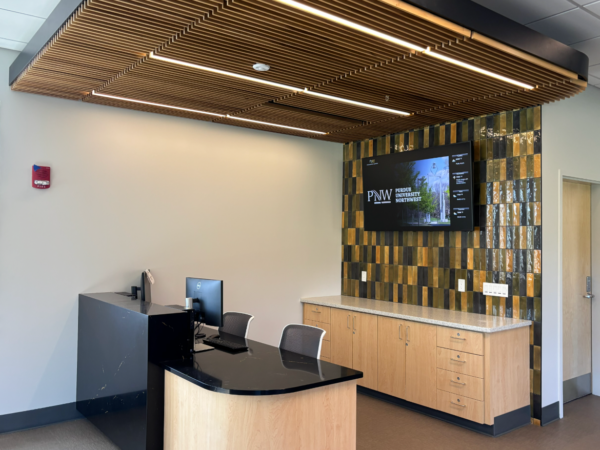
Day 1 registration: The expo was beginning to bustle on September 23.
The Status Quo
Has office imaging reached saturation? In terms of boxes, largely yes. Most offices that need an MFP already have one. Growth now comes from what surrounds the device: the applications, the workflows, and the markets next door—many of them on display in Las Vegas.
Every OEM offers top-quality hardware. Image quality, speed, and reliability are table stakes, and when everyone’s hardware is good, hardware alone is no longer the reason a customer signs.
It’s up to the customer to demand services and (digital) workflow optimization. Buying on a cost-per-page basis leaves value on the table. The better questions: How does this device fit my document processes? How much manual handling does it remove? What can its data tell me?
It’s up to the dealership to offer services and (digital) workflow optimization to stay relevant. Dealers can’t wait for customers to ask. Those who lead with workflow assessments, software, and managed services will own the relationship. Those who sell boxes will compete on price—even more so in the production and commercial space.
Our top PUE26 picks
Device to watch:
Xerox Proficio Jet CS1100 inkjet press. Xerox’s first B3 cut-sheet inkjet press (see above photo) runs up to 300 images per minute at 1200 × 1200 dpi on new Xerox-developed printheads, handles coated stocks up to 350 gsm, and targets transactional, direct mail, and commercial work. Commercial availability is targeted for Q3 2027.
Finishing to watch:
Kongsberg PCS. Kongsberg and its sister brand, MultiCam, made connected workflows the theme. The Kongsberg C ran with the Smart Material Handler, which lets operators load the next sheet while the current one is cut, so one person handles what typically takes two. A new MultiCam routing platform was slated to debut.
Specialty application to watch:
RISO MICRXpress. RISO’s new printer combines full-color cutsheet inkjet with MICR (magnetic ink character recognition) code check printing. Most MICR printers print only in MICR ink. The MICRXpress runs full-color simplex and duplex documents at up to 160 ppm and adds a separate head for the MICR line. Only that line uses MICR ink, so one cartridge lasts about 140,000 pages, and checks print on plain perforated paper instead of specialty stock. It goes on sale in North America on October 1, 2026.
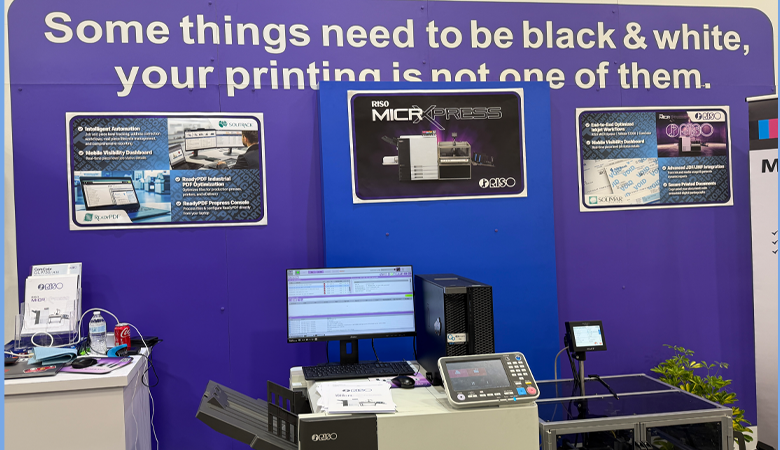
RISO’s MICRXpress is a full-color inkjet device (160 ppm).
Small/diversification opportunities to (re-)discover:
Sawgrass, Brother. Sawgrass VersiFlex turns the desktop SG500 and SG1000 into decorating systems for cotton, linen, wood, and drinkware, with no separate DTF or DTG equipment. Brother’s DTRX combines 32-inch roll-to-roll DTF printing, powder application, and curing into a single system.
Wide/large-format powerhouse to watch:
Durst/Vanguard. Durst took a majority stake in Vanguard in 2020; in Las Vegas, the two ran an integrated booth as one Durst Group. Durst brought the North American debut of its P5 350 CORE hybrid, Vanguard brought its Radnor hybrid. Together they earned 13 of this year’s Pinnacle Awards – nearly half of all output categories.
Intelligent production print devices to watch:
Canon, Fujifilm, Kyocera, and Ricoh—to name a few. Canon, the show’s title sponsor, debuted the imagePRESS V900 II and added an API to its PRISMAlytics Dashboard, allowing press data to flow into customers’ own business systems. Fujifilm’s flagship Revoria Press PC2120 brings AI-driven automation and one-pass six-color printing, including a new green toner. Kyocera rolled into Vegas with two new inkjet configurations: the TASKalfa Pro 15000b monochrome production press and the TASKalfa Pro Tandem, which features two print engines for a duty cycle of 5 million images per month. Ricoh’s show focus was connectivity: Production printing requires fast job turnarounds, yes, and workflow integrations can expedite the need for speed.

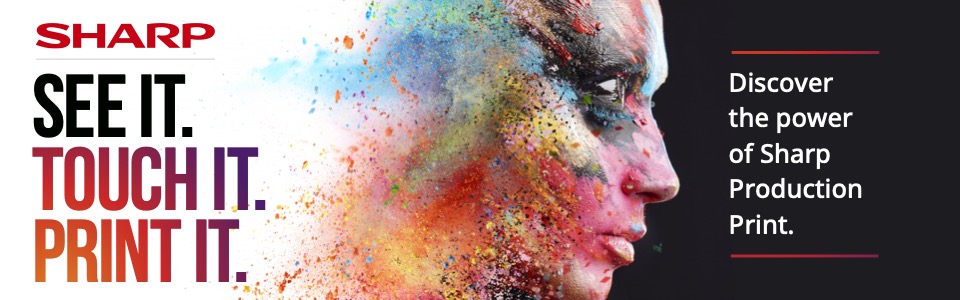
We met Canon’s cool cat on a show-floor display (a colorful image, that is!).
Social responsibility initiative to watch:
Sharp–Mariano Rivera Foundation. Sharp is in its third year partnering with a vocational foundation to train and certify young people as MFP technicians, six of whom graduated this past August.

Why was New York Yankees’ Hall of Fame closing pitcher Mariano Rivera in the exhibit hall?
Talk of the tribe to listen to:
Embellishment—still, and still growing, as an offering, and business and security opportunity. Konica Minolta introduced Embellishment Forge, powered by Adobe Print Services, which lets designers create production-ready embellishment files from standard PDFs. Sharp previewed two color presses supporting gold, silver, white, pink, clear, and textured-paper toners, and added Visualis3R software, which shows customers realistic previews of foils, spot UV, and embossing before a job runs. Xerox added gold, silver, and white fifth-color options to its Proficio PX300 and PX500, and Fujifilm showcased metallic effects on its Revoria Press PC2120.
The omnipresent elephant in the room:
AI is, and will be even more, part of every aspect of printing.

AI was, well, everywhere in Las Vegas.
The Future is ours to build
However, one question came up in almost all of my conversations: What goes out the door when the current experts retire? How do we collect and benefit from the tribal knowledge that lives inside those heads? The answers were quite surprising: from “we haven’t really given this much thought yet,” to “we are adding more intelligence to our hardware and software,” to “we are actively working on how to make everything we’ve captured from our experts over the years accessible for the next generation,” to “we meet and mentor and educate our teams on a weekly basis.”
For dealers, that is the opportunity: capture what your experts know, mentor the next generation, and turn that knowledge into services your customers will pay for. I am delighted and hopeful to see a prosperous future for printing ahead!
COMING SOON:
Stay tuned for Editor-in-Chief Mark Vruno’s production printing takeaways from PRINTING United Expo 2026.
*No, the robots did not take over; in fact, they were hardly present. Automation? A different story all together!

Farewell until we meet again next year in “Vegas, baby” . . .
About the Author: Petra Diener writes The Cannata Report’s “Outside the Box” column.