

We all know that attracting young people to this industry is a huge challenge. It’s refreshing and optimistic to chat with Ben Johnson, who, at the relatively tender age of 40, has been running Woodburn Company in Washington state for almost a decade, turning it into a leader in the managed print services space.
Woodburn Company began its corporate life as an A.B. Dick Company branch, but it’s about as far from installing and servicing small offset presses as a horse and buggy is from a high-performance Ferrari.
“We are a very niche player in the enterprise managed print space. We are very focused on larger organizations that are really focused on major enterprise IT-led initiatives,” said Johnson. “We specialize in really transitioning organizations from OEM-led programs and legacy hardware-centric models to a solution-driven type of model.”
Many in the enterprise space are still focused on device placements, the cost-per-page model, and the OEM singular stack, said Johnson. What Woodburn is capturing are organizations looking for suppliers who can fit seamlessly into the overall enterprise IT ecosystem.
“We specialize in truly embedding within these enterprise teams. We become the print team of a large enterprise. It could be a Fortune 500 company, a major regional organization. It could be large government. We are their print team within their overall IT structure. And we embed our people and their processes, their procedures. Very, very little of our focus is just on selling devices,” he explained.

Data Center server racks on site at Woodburn Co.’s Seattle headquarters.
The process might look something like this. Woodburn begins by managing a client’s current printing equipment, service providers, billing, fax and scanning, and third-party providers. Perhaps Johnson’s people build an architecture of that environment based on governance and policy, gaining a grasp of the client’s goals and initiatives, and managing the process in the short term.
Next, Woodburn spends a lot of time on workflow, which might include jobs like managing the creation and data associated with utility bills, for example, creating a platform to manage all the technology that’s generally very decentralized. “And then what that immediately gets into is, ‘Can you go fix all these different pockets?’ And so we could end up with five or 10 different lines of business in an enterprise,” he explained.
“We compete against those that are coming into a large utility and saying, ‘Hey, why don’t we take over your helpdesk services? Why don’t we take over your network infrastructure management? Why don’t we be your server team? Why don’t we be your printer team?’ And, where we’ve had to position ourselves is kind of smack in between the largest of the managed service providers, the OEM-direct programs, and the SaaS service providers,” Johnson explained.
The print side of things, he said, has some unique experiences. It sits right in the middle of hardware, IT services, and service providers, and knowing how to handle service calls. “We saw that, and we said, well, we can be that operational glue. We can be that platform that’s connecting all these different dots together,”
Working from Woodburn’s Seattle headquarters, Johnson cites clients in government, healthcare, and human services, largely located in the Pacific Northwest. Nine other locations support the company; none of them are sales-oriented.
A non-traditional tech entrepreneur
Three things stand out about Johnson and his company:
- He sounds much more like a cool tech entrepreneur innovator than a traditional manager in the dealer ecosystem. Tech speak seems like second nature to him.
- Woodburn has probably one of the most low-key web presences out there, with a website that doesn’t even list services offered. It’s all by design, Johnson says, as they prefer to fly under the radar and rely on word-of-mouth. The strategy seems to be working.
- He’s the only direct-sales person in the company. “We do not operate a traditional sales team,” Johnson said with humble understatement.
In fact, most of his staff of roughly 50 employees consists of an in-house development team that builds various tech tools, field service personnel, and a program management team that manages all client relationships and identifies projects within large enterprises. “In large enterprises, there’s a run rate of 36 to 48 months of projects in the pipeline that are well identified,” he explained.
Woodburn Company got its start as an A.B. Dick Company branch back in the 1920s. In 1957, Jack Woodburn acquired the branch when the small-offset press OEM was deemed a monopoly and broken up. Woodburn functioned as an A.B. Dick Company service provider for quite a few years until it also became one of Ricoh’s original dealers in the United States.
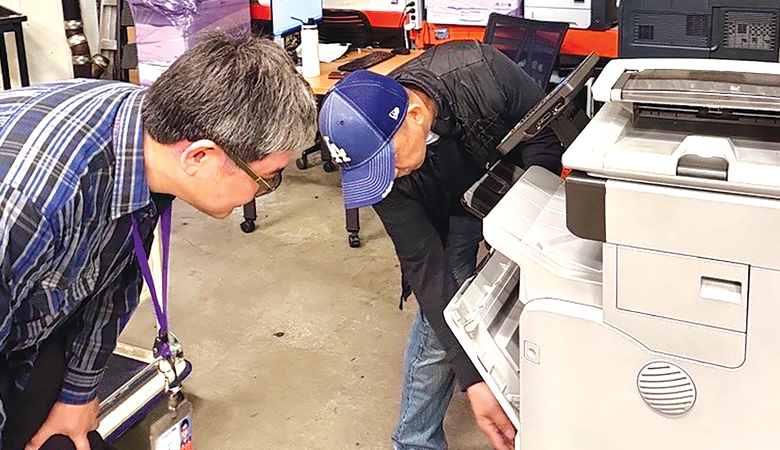
Today, Woodburn’s support teams drive enterprise print and workflow initiatives.
Frank and Penny Fukui acquired the company in 1989. Frank also came from a technical background with A.B. Dick, so the company stayed the course as it expanded services to other geographies. Though he is retired from active work, Frank remains a close and trusted advisor to Johnson.
Woodburn, in its current incarnation, is largely OEM-agnostic, but it remains a Lexmark and Ricoh dealer and has expanded its hardware offerings to HP, including wide format, and has access to distribute Xerox devices.
“The company has migrated through every technological change. What’s impressed me over the years,” Johnson noted, “is the company really has been on the forefront of those changes, from offset presses and analog, to digital, to managed print, to, you know, tech-centric services.”
Johnson started his career at Lexmark International in 2008, finding his way to this industry via a serendipitous course. While working on his undergraduate degree in international business and French, he took an internship with a large bank, thinking the financial world would be interesting. It wasn’t. He wanted something more entrepreneurial. But he figured that if he was ever to start his own business, he had to learn how to sell.
He looked at IBM and Xerox, both regarded as world-leading sales training organizations back in the ’90s and 2000s. Neither of them had a position. Johnson followed the paper trail, as he liked to say, to Lexmark, which IBM had spun off in 1991. Lexmark had a position open, and the rest is history.
“I had no clue what I was getting into. I knew nothing about printers,” he said. But he received excellent training. “I learned quickly how to get ideas in front of other people and gain buy-in . . . and then that’s where we got into the software side.”
A new wave dealer since 2014
One of his clients was Frank Fukui at Woodburn. “Frank said, ‘Why are you partnering with me? Why don’t you just run this thing yourself?’ We were doing a lot of business together. We were partners over a number of my years at Lexmark,” he remembered. In 2014, Johnson bought the business and began charting its next course.
Johnson’s entrepreneurial bent was honed since childhood watching his parents navigate their careers. His father was a pastor who moved his family every four to five years, serving in ever-larger churches. There were many voices to listen to and politics to navigate. “I’d say, in business, we do the exact same thing. You have to know how to have restraint and manage conversations and expectations,” he said .
Meanwhile, his mother started and owned preschools in each town the family moved to, which basically meant starting a business from scratch every few years: marketing, finding locations, and recruiting students.
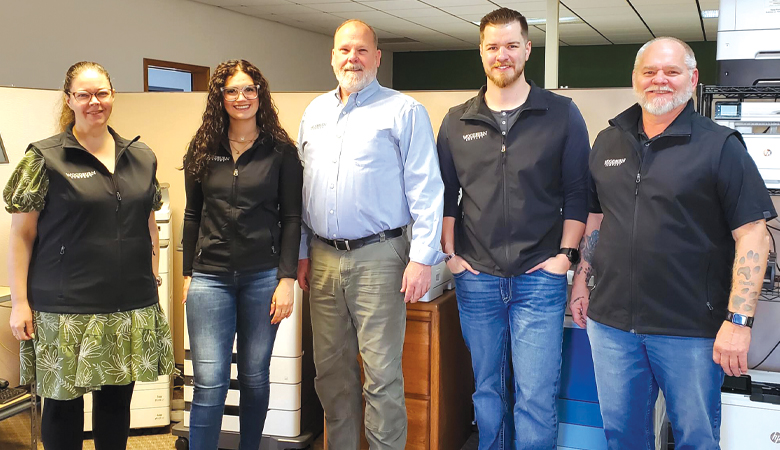
The Woodburn field service operations team delivers responsive, on-site support across the region.
As an undergraduate, he regularly experimented with startups, including a couple in software development, one of which did well. “I ended up, kind of in parallel to undergrad, getting deep into the development world, and have carried that forward,” remarked Johnson.
Asked about the next three to five years, Johnson talks about growing as a consulting voice to ensure that the enterprise IT stack returns value, moving away from closed, proprietary tech stacks to open ones, becoming competitive with senior-level technical roles, exploring cloud engineering, and data centers. Automation is a huge opportunity, he added, and the impact of AI, which in all likelihood will kill software as a service (SaaS) because of its ability to write software at will with a few prompts.
If reinvention is a hallmark of a successful company, Woodburn may be on the cusp of its most ambitious transition.
RELATED READ:
CR CONNECT – DEALER TOUR
South Carolina-based Dealer The Office People Designs Tech Experiences
Watch The Office People video.