
Turns out, MFPs can be affected by the COVID-19 virus. So much for plastic, aluminum, and silicon being immune to biological afflictions. There may even still be aftereffects.
Two entirely different threats having an impact on the office technology market came one on top of the other. As Lee Flood, president of Pearson-Kelly Technology, a Missouri-based mid-size dealer, explained, “We saw a decline in new leases and lease upgrades during COVID. As business began returning to normal in 2021, our industry faced shortages of hardware, parts, and supplies that resulted in a slowdown in both new leases and upgrades.”
Flood is stating the facts. Throughout 2020 and 2021, most OEMs saw demand for printing and copying decline by up to 35%. Mitch Leahy, senior vice president and general manager of office equipment at GreatAmerica, a leading equipment lessor in the office technology space, reflected this. “The long-term effects are still unfolding,” noted Leahy. “We expect to learn more as leases on equipment installed after supply chain recovery begin reaching end of term in 2027 and 2028.”
While Leahy noted that usage appears to have stabilized, some dealers are seeing lower device utilization than before COVID. This may be influenced in part by the increase in remote and hybrid work at their customers. Part of this could be due to work being done using fewer machines, such as individual MFPs that can produce output once requiring three devices. More importantly, it pressured OEMs, lessors, and dealers alike to take a fresh look at their customers to see how they are using the machines at their disposal.
Leahy said GreatAmerica took several steps to help office technology dealers and their customers navigate uncertainty. “For customers facing financial challenges, we granted payment deferrals upon request throughout 2020 and 2021,” he said. “This was well received and helped keep delinquencies under control.”
More A4?
An A4 printer is a good fit in many home offices. After returning to the office, many hybrid workers have been reluctant to give up the convenience of such machines. Although any company-owned printer in a remote worker’s house is likely to be used for non-business purposes (such as a child’s homework), it’s an inexpensive perk, and many companies don’t notice the small increase in page counts, service calls, increased use of ink/toner, etc. In some companies, however, remote workers are expected to buy their own toner/ink or paper.
“We saw an increase in the sale of A4 devices,” said Flood. “Some of this reflects the direction the industry was already moving, but I believe COVID may have accelerated the trend.”
Most OEMs have been quick to address this, offering machines well suited to remote or hybrid employees. While some companies (quickly or grudgingly) placed leased devices in employees’ homes, there may not have been an appreciable change in the number of pages printed, and some pages created digitally remained digital. On the other hand, utilization of home office machines purchased online or at big-box stores is not monitored.
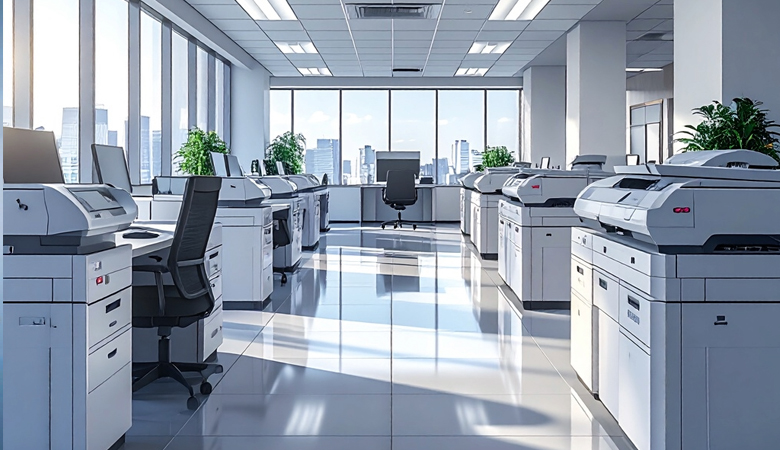
Many office copiers and printers merely collected dust during the COVID lockdowns.
Re-evaluation drove responses
“COVID forced companies to re-evaluate assumptions about how people work and how offices operate,” said Mike Marusic, president and CEO of Sharp Imaging and Information Company of America. “With machines being underutilized and prices and lease rates higher than when they originally acquired the devices, companies were [and still are] hesitant to accelerate any changes to their fleet.”
As the calendar flipped to 2021, the pressure of COVID was replaced by supply-side shortages. For a time, both challenges pressured many firms. Businesses wanted to print but were unable to obtain the latest machines due to broad supply-chain troubles. Although sales revenues declined, many OEMs accelerated a pivot to what came to be termed the digital workplace.
According to industry analyst firm Keypoint Intelligence, supply-side shortages impacted hardware sales more severely than other parts of the business. On the upside, “Every manufacturer faced the same delays because they were all drawing from a constrained global supply,” noted dealer LDI Connect on its website. While there is little one could really do, the lesson for dealers is to grease the gears of progress in advance, be politely persistent, and pull in favors whenever possible. You know the drill.
As a mid-size dealer offering more than one brand of device, Flood noted, “Return-to-office patterns have varied across the board. Data from our managed print services indicates print volumes per device remain below pre-pandemic levels.” Sharp’s Marusic saw similar shifts, even as the industry emerged from the pandemic. “Customers wanted flexibility because nobody knew what the future workplace would look like. We saw office tech businesses looking to extend leases, delay refreshes, consolidate fleets, or re-evaluate device placements.”
Less printing since COVID
Some of your customers may have mentioned that MFPs and other devices you sold them in the waning days of 2019 or early 2020 — before the pandemic and supply chain problems—have run only a few thousand prints yet may still be due to be replaced according to their lease agreement. This is not isolated to any one OEM or lessor. While the financial impacts of COVID and electronic shortages varied based in part on an OEM’s business model, none escaped unscathed. Likewise, some dealers and OEMs emerged from this period with somewhat less fiscal stress than others. Those with services beyond copying and printing (such as managed IT or electronic signage for point-of-purchase displays) seemed to emerge stronger than those primarily reliant on the copy/print model. This is a key reason for placing less reliance on printing and more on managed IT and other services.
Dealers following an OEM’s strategy of offering a complete office suite that matches end-users’ desire to expand can demonstrate an interest in helping grow individual customers’ businesses. This helps solidify a relationship spanning the dealer, customer, and OEM.
Sharp’s Marusic suggests this strategic view: “One positive outcome of COVID is that it separated OEMs with respect to how they served their dealers during a challenging period. We took a very proactive approach in supporting dealers, which allowed them to compare approaches during a challenging period. This has created stronger bonds coming out of the COVID period.” Big picture: OEMs that positioned themselves in this way are better able to support dealers moving forward.
We roll this out as a means of preparing you when the next pandemic or supply-chain crisis comes up. Work in advance with your OEMs, banks, and financing firms so you have at least a sense of how they are likely to react when the dragons call. They will all respect you for thinking ahead and appreciate your being prepared for things to go totally sideways.